
Are you moving in Movember?
In conjunction with the NHS initiative Movement 26.2 to get people moving more we’ve had our clinic team and patients recording their step count. Here’s our data for average daily and weekly step count alongside the month totals.
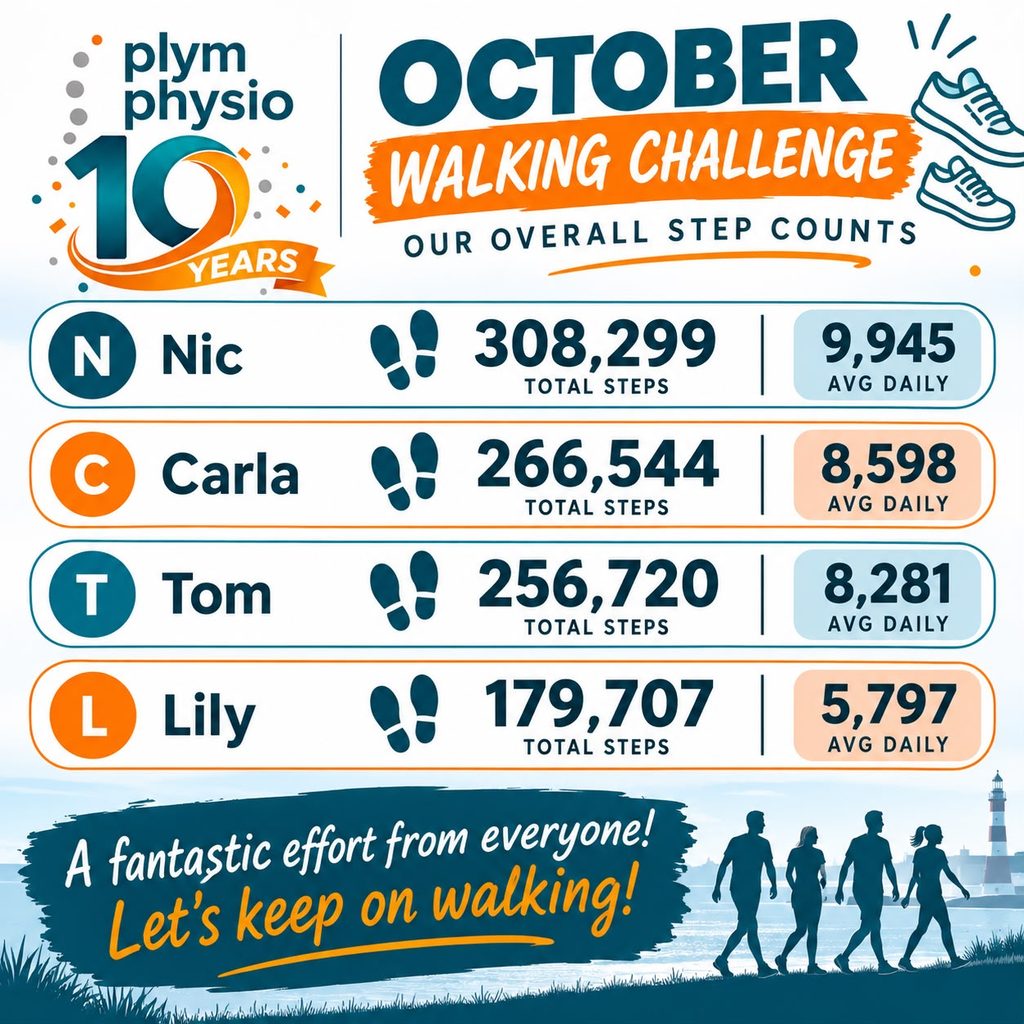
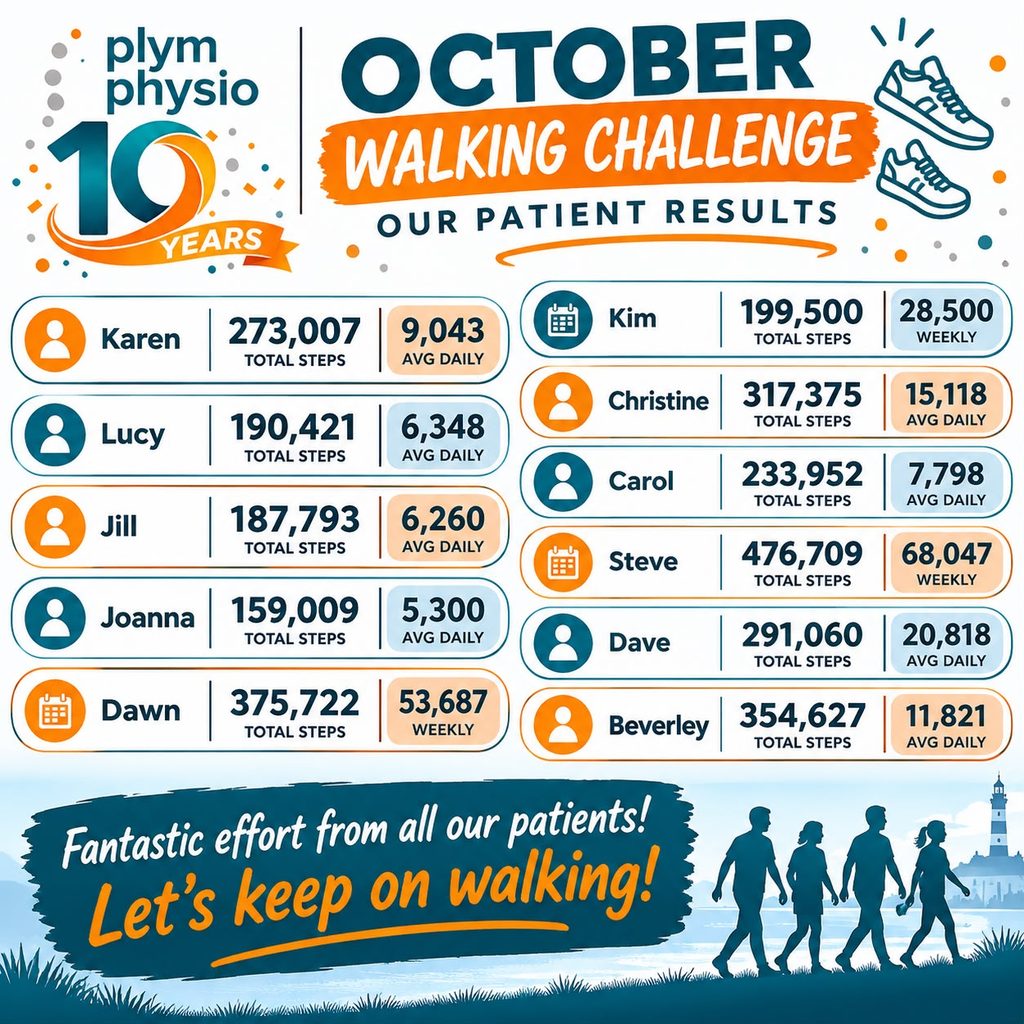
The NHS has done the basic maths and calculated that 30 minutes of walking a day for a month equates to approximately 26 miles and therefore a marathon distance. The obvious issue is that everyone walks at different speeds with different stride lengths but lets not get bogged down in too much detail because the principle is great. Why?
Having done a bit of research…..
- It found that as few as 2,337 steps a day started to lessen the risk of dying from heart and circulatory diseases, while at least 3,867 steps reduced the risk of dying from any cause.
- every extra 1,000 steps a day was linked with a 15 per cent reduction in the risk of dying.
- For people aged 60 and over, the biggest improvement in health was seen in people taking 6,000 to 10,000 steps
- For younger ages, it was between 7,000 and 13,000 steps.
Do you know how much you do now? It’s probably worth knowing so you can see how close or far away you are from your ‘target’ distance.
- Under 18s: Aim for 6,000 to 15,000 steps per day
- Adults (19 to 64 years): Aim for 8,000 to 10,000 steps per day
- Older Adults (65 and over): Aim for 6,000 to 8,000 steps per day
Depending on the length of your stride, 10,000 steps is almost five miles or eight kilometres. It would take most people between one to two hours to walk 10,000 steps, if they did it in one go. Walking 10,000 steps burns between 300 to 800 calories, depending on your weight and height.
So walking looks like it could be a really good solution for a lot of us. It’s free and if we take into account another bit of research, a recent large-scale study suggested that how fast you walk could be just as important as how far. So for those that perhaps don’t have easily accessible roads, paths and tracks, a shorter distance done with more oomph could provide similar results.
From a Physio’s perspective there are some other considerations that might be worth taking note of. A 30-year study tracking over 110,000 adults published in BMJ Medicine found that people engaging in the greatest variety of physical activities had a 19% lower risk of premature death than those who focused on just one activity. So you could use minutes of various activities rather than just steps to hit some better health targets.
- Adults (19 to 64):
- At least 150 minutes of moderate-intensity activity per week (such as brisk walking, cycling, or dancing), OR
- 75 minutes of vigorous-intensity activity per week (such as running or fast swimming), AND
- Strength exercises on 2 or more days a week.
- Minimize prolonged periods of sitting and break up long stretches of inactivity with light movement.
- Older Adults (65 and over):
- Aim for 150 minutes of moderate-intensity activity weekly as able.
- Focus heavily on activities that improve balance, flexibility, and muscle strength (e.g., tai chi, yoga, or carrying heavy shopping) to reduce the risk of falls.
Within our team of adults the physios do a mix of activities; strength training, running, swimming, rugby and hit the 75 minute vigorous intensity bracket. Lily is a self-confessed exercise dodger so sticks with walking – we’re wondering if we can persuade her otherwise now…??
Feeling motivated? The darker, colder months are upon us so if getting your trainers on and hitting the roads doesn’t float your boat you can still improve longevity and mortality risk in other ways.
- Use minutes of activity rather than steps
- Use smart watches to ‘measure’ intensity via heart rate
- A variety of activities rather than just walking
- Classes taken by professionals that takes the decision making out of your hands – turn up and do as you’re told!
If all this sounds great in principle but not sure where to start, Plym Physio has a range of options for you. You don’t need to be broken to get Physiotherapy. If you want to start your journey to a healthier life then we can help with an assessment of where you are now, where you’d like to get to and help decide what the pathway looks like. From movement essentials and efficiency in the Pilates class, improving functional mobility with older adults in the Balance & Strength class, introduction to resistance training in the Active & Able class to our high end Strength & Resilience class we have something for everyone.
References;
- British Heart Foundation
- British Medical Journal
- NHS UK
- European Journal of Preventative Cardiology